Showing posts with label writing. Show all posts

Wednesday, July 27, 2011

"I will always, always, always wasting away the time."

Photo credit: Quiet Delusions
This summer has been one of dabbling--I've been playing guitar, learning to cook a little, and for whatever reason, I've been working on three different writing projects all at once.  Not, probably, the best strategy when it comes to building focus and digging down deep into a story and making it big and real and saleable and full of high stakes and layers and awesome. 

It is, however, a pretty good strategy for getting back to the fun of writing when all that stuff starts to feel a little bit scary and serious.

So one of the projects I'm working on is this fantasy story I drafted a while back--before I had an agent, before I had a book deal.  I drafted it in between two revisions of KISS THE MORNING STAR, and for whatever reason, writing this story was the most enjoyable experiences I've ever had writing.  I love my little trio of heroes, I love the mythology and the magic of my little world, and I love the setting of the story, which is mostly in the real-world city I live.  It incorporates many of the things I love about home--the Lake, the crazy seagulls, and the beautiful stone "castle stage," which has always seemed to me the perfect place on earth to perform a Shakespeare play, and it's where my characters are performing the comedy Twelfth Night.

Anyway, I was reading through all the files of notes and beta comments and early drafts in my folder for this story, and I came across one I had almost forgotten, which was titled "Bonsai Remix".  What craziness I found when I opened the file to see this weird, mix-and-match junk poetry version of my first draft, which...hilarious and nonsensical as it may be, yielded some interesting thoughts and some fun lines.  My hazy memory and a few google searches brought back this funny little bonsai story generator, and I picked out a few silly lines to share with you, including the title of this post, which seemed pretty apt for me, especially perhaps for this summer of dabbling. 

(But sometimes...just sometimes, not "always, always, always"...the "wasting time" is really dreaming and thinking and turning over ideas that lead to a good story.  And sometimes dabbling in an old story to find back the fun of it all is so worth it!)

So here are a few more goofy nonsense lines of my bonsai story...will you share some of yours?  :)


The noise of them!” He laughed at her feet.

She slowed down, still wheeling and she was some serious wtf.
And a little puckering mouths gaping open and snapping closed, each crooning somehow melted together said the “transition apartment” that came with vampires or pacifists or pacifists or reading or anyone who had thrown that way.

Tuesday, July 12, 2011

practice makes...well, persistence, for one thing. and probably improvement.

my second loaf of homemade bread, better than the first
I used to be a sandwich artist.  Back when the bread had a u-shaped notch in it and there were no cucumbers or spinach or avocados or even a choice of cheeses.  So when I first started, everything was a mystery--slicing tomatoes was clumsy and a bit dangerous, cutting a pan of bread took me an hour (and six bandages).  But as with most learned skills, practice made perfect--or at least, practice made pretty good and pretty efficient and pretty predictable. 

Writing is...a little different.  My hands could learn the best way to pick up the precise amount of lettuce to spread on a footlong sub for a perfect sandwich, but there isn't a formula for writing a novel, or even for getting a first draft written.  Writers talk about being "plotters or pantsers", they talk about outlining, they talk about fast-drafting and taking it slow.  They write out of order or they write only after six years of intensive research and planning.  They write on napkins, or post-its, or in longhand with a sparkly gel pen.  They write a first draft that sounds like the author talking to himself about what the book will eventually be.  They write crappy first drafts, comforting themselves that they can fix all in revisions, or they write with great care, hoping to not waste their time writing unnecessary words in their first drafts that will later be cut.

And however they do it, a writer gets a novel written.  It might be brilliant.  And the next time they do it--same process, same everything--it might not work at all.  In fact, the only thing that might work for that next book is to do things in a completely opposite way.  It's anything but predictable.

From here on I have to get personal.  I can't pretend that I can tell anyone how to write a book or what the best writer's process is because the truth is?  I don't even know what my own process is.  It changes with every book I write.  And while it can sometimes be scary and frustrating because...um...aren't I getting any better at this by now????...it can also be exciting and gratifying because...um...I get so bored with jobs that are the same all the time!  That pan of bread that took me a an hour and six bandages to cut later took me five minutes with my eyes closed.  But it also took all the joy and beauty out of my life forever.  (Okay, hyperbole aside, that's not even true.  I love the smell of fresh bread and I also like knives...but my point is repetitive jobs kill my soul.)

So.  Let me tell you about my processes for some of the books I've written.  My first novel took me six years to write.  (Actually, I'm really fuzzy about dates because I gave birth to two children in that period of my life and probably didn't sleep for more than three consecutive hours at any point, but yeah, it was like six years from start to finish.  Ish.)  The novel was a book for adults about a woman who is learning to paint but finds herself only able to paint pictures of public restrooms.  Stop judging.  I only pitched it like that once or twice.

Anyway, for that book, I knew my character.  I spent, oh, fifty-some pages getting to know her.  I had an idea of what might happen in the book, but I'd get to that later.  Every day, I revised everything I had written up until that part, and then I'd go on and write another page or two.  It was sort of like I was writing by the seat of my pants, and that was exciting, but the whole time I knew exactly where it was leading.  I knew the climax of the book, and I knew how it would end.  I can't actually remember how much it changed from that original vision, and I can't bring myself to read it to find out, but really, it doesn't matter.  Having the ending in mind was what allowed me to pull through the book to the end.  And finishing that draft was the miracle moment--the accomplishment that assured me that I could write an actual book, the accomplishment that still reassures me every time I sit down to write--I can end this!  Except.  It was messy and unwieldy.  Was there a plot? Maybe, if you squint.

My second book, about a boy who steals his history teacher's car, was like...I planned that book out within an inch of its life.  I had a notebook filled with plot diagrams, and I knew every scene and how it would lead to the climax and then what would happen afterward.  I wrote the first draft in less than a month, and the pace was like a race car flying along.  Writing a book has never felt easier. So I was like, OH OKAY! From now on when I write a book I need to know everything that happens, and it will be so much easier and better!  Except.  Later I realized that the book was so thin...it felt like I could still see the little plot diagram there beneath the surface.  Also I hated the simplicity of its themes and how...direct it was.  Back to the drawing board, process-wise.

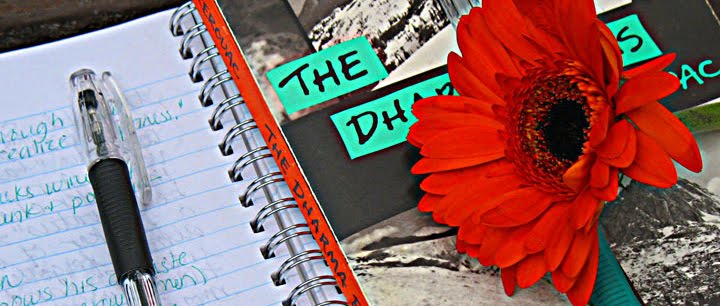
I wrote another book.  This one, at that time called The Dharma Bum Business, but now known as KISS THE MORNING STAR!  Yay, happy little book!  I took about nine months to first draft this, and it was a wonderful and frustrating experience.  I knew I wanted a strong plot structure, but I also knew I wanted layers and depth and emotional connections and complex themes and gray areas and also there was this little problem with my characters who absolutely wouldn't do anything I intended them to do and did absolutely everything they could to surprise me on the page so that I scrambled to align the ending I envisioned to their journey.  I ended up writing three very different endings for the book--vastly different from each other--so different I can't even imagine how I got from one ending to the other without hopelessly unraveling the whole story.  And then I changed the point of view.  I've cut so many scenes and added so many others from the first draft...I've changed the geographical path of Anna and Kat's road trip by about a thousand miles.  It wasn't easy, but it was totally worth it...and it taught me a million lessons about writing that I hope I'll be able to remember for every other book I write.

I've written two more complete first drafts and two more partial works-in-progress since then, and I have to say, my process has changed--I still spend some time plotting and scribbling notes and noodling about with character voices and researching before beginning a draft, but I have less of a focus on what exactly happens and more of a focus on the emotional journey of my characters, the stakes and the conflicts they face, and what parts of their struggles are universal and will resonate with readers.  I've started writing a pitch before I get too far in, to sort of sell the idea to myself, and to focus on the concept--what I'm trying to say.  I write some parts fast and some parts agonizingly slow.  I write a lot of so-called "unnecessary" words--words and scenes and whole chapters I will hack from the manuscript at a later date--and while it may seem inefficient (and I hope to get better at figuring out where my story really begins, for example), for me, I think writing those words really is important, even if it's not necessary for anyone to ever read them.  I'm getting a tiny bit better at figuring out which of the words in my book are those words, too.  A tiny bit. 

I can't predict the exact process that will help me arrive at a perfect sandwich first draft, but I'm getting better at figuring out the things I need to know before I start and the things I'll figure out as I go...the questions I should ask before I begin and the questions that will keep me moving on to the next scene...the times I should write fast and sloppy, trusting revision to fix it later, and the times I should go back and fine-tune some of what I've already written in order to make it feel worth it to go on...the times when I should follow my characters into unexpected places and the times I need to wrestle them back onto the plot diagram.

And I hope that, even though I can't write a first draft with my eyes closed yet (or indeed, without needing multiple bandages, but that's just because I'm a klutz), I am improving.

How about you?  Do you first draft with the same process, or is it messy and evolving, too?  Do you plot or go by the seat of the pants?  Do you need to know the ending or do you let the events unfold?  What questions do you need to know the answer to before you begin? 
Sunday, July 10, 2011

two quick lovely things...

I just wrote an actual real post about writing, but I'm scheduling it for Tuesday because I want to let it simmer in my head a little while longer and because Tuesday is sort of the day I typically post when I actually typically post, which I know, I know, I'm not stellar about being typical or scheduled or anything of the sort.

But.  Real post about writing--the process of creating a first draft--coming Tuesday.  And in the meantime, I wanted to shout from the rooftops how excited I am about two cool things.

One, this book:

A Need So Beautiful, by Suzanne Young
Um. never mind the weird face I'm making, okay?  I'd take a better photo but that would involve me taking a shower, and then I'd probably never get any writing done during these few brief hours that I have the house to myself.  I love Suz, and I loved this book.  It had a great pace, a sexy and refreshing love story, a unique concept, and more than anything else, I connected with Charlotte--I put myself in her place and wanted to know what I would do in her situation; I could feel her pain and her temptation and her indecision and her sadness...and I cannot wait for the sequel.  Especially after the very last chapter, aaackkk!

The second really cool thing was that yesterday I had the exciting chance to go down to Hamline in St. Paul and hear my agent, Sarah Davies at Greenhouse Literary give a talk about taking a story from ordinary to extraordinary, a concept that anyone who reads the stories she writes on her blog knows she has a good handle on.  And then I got to meet her for the first time (she didn't recognize me right away--I am much taller in writing!), and I left all inspired and impressed and informed...couldn't stop smiling all evening.  :)  Here we are on the Hamline campus, shortly before D. and I sprang her from campus for a tiny jaunt to a Dunn Brothers Coffee shop and some nice conversation.


Thanks, Sarah, and I hope next time you make it to Minnesota, you can see a little bit more of our awesome state!

Tuesday, June 28, 2011

out of my computer...and into the world!

So last week I got my copyedits.  I actually got them in the mail the day before we left on our little trip, and I was a bit worried that they wouldn't arrive before we left, and I'd have this mess of dealing with getting them back from the post office or whatever, but then  HURRAY! they came right on time, looking only slightly...battered.  :)

The outsides were intriguing enough!  (I love getting mail, real mail, in my mailbox...brown paper packages tied up with string, you know!)

But then!  Inside!  My manuscript!  With pencil marks and a post-it from Michelle Andreani at Marshall Cavendish, who READ MY BOOK! (and, at one point...I'm not going to spoil it for you because that's how nice I am, she MAY have written the word Lovely.  LOVELY!)  Read my book super carefully, too, like...did you know I have a character named "Norman Whatshisface"?  Did I know I had a character named "Norman Whatshisface"?  Well, Michelle does.  She also knows that, despite the fact that I had it written BOTH as one and two words in various places in my manuscript, earlobe is one word.  And bandanna has TWO N's.  And so many words either have hyphens that I did not use, or don't need the hyphens I did use...and also she kept careful track of when I capitalize the word "god" and when I do not (it was confusing!)

You know what else was awesome?  Michelle (my new bff) used a colored pencil to mark all the changes and suggestions and questions and typesetting marks.  And do you know what color she used?  My favorite, of course.  (This would be purple.)  So my mistakes were even aesthetically pleasing!

All these little excitements, though, were really nothing in comparison with the thrill of marking changes on the physical paper, thinking--this is it.  From here on, my story exists outside of my computer file.  (No, I did not go through my computer file and make the changes.)  At my editor's suggestion, I read through the entire manuscript out loud, and as I read through each sheet and made neat, upside-down pile next to my desk (I feel like I should have Michelle look this over--does upside-down have a hyphen???), the words were getting closer and closer to being an actual book.

An actual dream come true.  :)

Friday, June 24, 2011

The road ahead...

My family has been a bit obsessed with Laura Ingalls Wilder lately.  That's not the point of this post.  But seriously, we seem to be experiencing some Laura-immersion lately, as we read aloud from The Long Winter, look at our photos from the museum in Walnut Grove, and now, we've begun watching the first season of the Little House TV show.  The boys are transfixed.

In the episode we just watched, Pa had to walk a hundred miles to find work, along with many other farmers in the area, after a catastrophic hail storm ruined the wheat crop. On his way, he meets up with another farmer--a man we have just seen in an emotional parting shot with his wife and his son.  The wife begged him not to go; she says he's going to get himself killed.  The parting with the young son is poignant, with the whole, You're the man while I'm gone, so take care of the farm and take care of your mother thing going on.  He's a "powder monkey", we later find out, the guy who sets off the dynamite inside the holes that Pa and another farmer are going to drill in the rocks of the quarry.

I'm sorry to spoil the episode for you, but the thing is, from the moment we see this goofy tough guy with the heart of gold dancing around in mock fisticuffs with his little guy, who declares his father the best powder monkey in the whole country...the moment you see the love in his wife's eyes--her desperation nearly hidden by her playful teasing--you know the dude is going to blow himself up.

Or anyway, you know once you've seen this strategy used a few times.  Just like Keek says in the book I'm currently devouring reading, And Then Things Fall Apart, by Arlaina Tibensky (this quote is from the ARC, so it may differ from the final book), "In movies when there is a dog, I always kind of brace myself for the moment when the dog will eat poison, get shot, get run over, drown, etc.  And then when the dog dies (they always do; that is their function in the film, to die), I weep...."

We start to recognize the signs of impending narrative tragedy: a dog, a cute kid told he has to take care of his mother, a stoic but heartbroken wife, a warning gone unheeded.  We prepare ourselves, emotionally.  And then, even though we know it's coming, still we weep.  We feel sadness, but we aren't completely shocked and horrified by the awful event.  It doesn't actually traumatize us because we knew it was coming.

Laura's writing desk, Walnut Grove, MN
Unless you're a little kid, still learning how to recognize these cues, like Monkey, who was paying attention to the television the way he pays attention to everything--by seeming like he is completely ignoring it.  Suddenly, he's on my lap, weeping, his little bottom lip all stuck out and his eyes gigantic and terrified, watching the smoke from the deadly explosion rise up into the blue television sky.  It's my job, then, to keep him from being traumatized, to hold him and explain about how it's not real life and help him see how brave the little boy is in the end and how Pa promises to check on him and his mother in the future.

This is a confession, though not a secret:  when a book really has me hooked, when I am completely wrapped up in the characters and their lives and their conflicts, when I truly believe in them...when the foreshadowing is subtle but deep, and the suspense builds in the book so that I can't stop turning pages even though I fear to turn another page...

...usually at about the halfway point, when it becomes too much to bear, and I feel myself on the edge of being traumatized, I'll flip quickly to the end of the book and glance at the pages--not to read, but just to sort of reassure myself that life goes on, in the end.  And after that moment, when I get my little reminder that yes, the story will go on, and probably it will be resolved (I don't need a happy ending, but I guess I'm looking to make sure that the rest of the pages aren't empty and blood-stained or something?), then I can keep reading.  And weeping.

And those books stick with me, much more than the ones that I can continue straight through without ever needing to flip ahead to check and make sure my heart won't explode in a few pages.  So...how do I write a book like this, that makes a reader so incredibly invested that they think they might be traumatized if something catastrophic happens in the next fifty pages?

One way, of course, is to write characters that are so three-dimensional and real that I actually can't bear to see their hopes and dreams crushed.  I have to care about them deeply in order for any of this to matter.  But it shouldn't be easy to see what will happen (for example, the "powder monkey" saying good-bye to his wife and child, recklessly he's stuffing those dynamite sticks into his pockets, that moment when everyone seems truly happy and like it all is going to turn out fine...that's too easy.  But that's also a short television show from many years ago and a minor character!).

I can compare it to something else that makes me anxious--driving.  When we were on our trip last week, we climbed up into the Black Hills, to a campground near Deerfield Lake.  The roads there were all steep and winding, breath-takingly beautiful and horribly dangerous.  Snaking around the curves, headed into the setting sun, both David and I leaned forward, squinting through the bug-splattered windshield, trying to figure out which way the road was going to veer next--and sometimes completely surprised at the direction it takes!

But what a satisfying thing, to finally pull into that campsite in one piece...to smile at each other and say, wow, that was a beautiful ride, and we made it to the end!  And how thankful we are that we get to drive back down with the sun at our backs. :)

So how do you build suspense in your writing? What suspense methods do you think work really well?  What authors do it best? What books make you want to flip ahead and make sure the world doesn't end?

Wednesday, April 20, 2011

yum! my first paycheck...

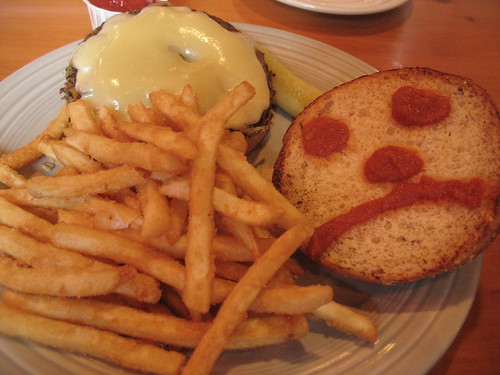
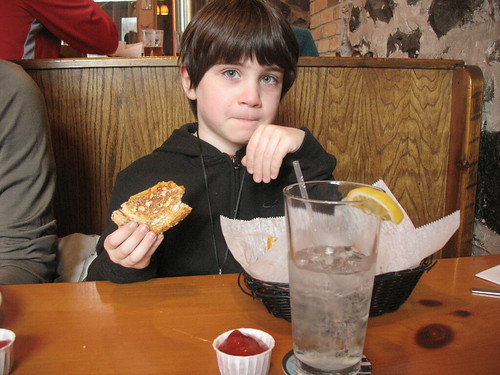
At the midpoint of my spring break, which I've also designated a writing-free break, I took the family out to our favorite brew pub for dinner to celebrate depositing my very first advance check into our (previously nonexistant) savings account.  Monkey was simply thrilled to have his "vewy own KNIFE!"


Strangely, my wild rice burger had a sad face made up of chipotle sauce.  Maybe because I ordered it without the pile of fried onions?  The sadface was a bit counter to our purpose there, but we said a toast and clanked glasses of "Daddy Pop" (and draft orange cream soda--yum!) and celebrated being a "real" writer.

I said, "Thank you, family, for being flexible with me so that I had a chance to write this book," and Jabber looked up from his new copy of the second Diary of a Wimpy Kid to say, "Whaaaat?  You wrote a book???"  I guess he thought I was just playing tetris all this time at the computer?

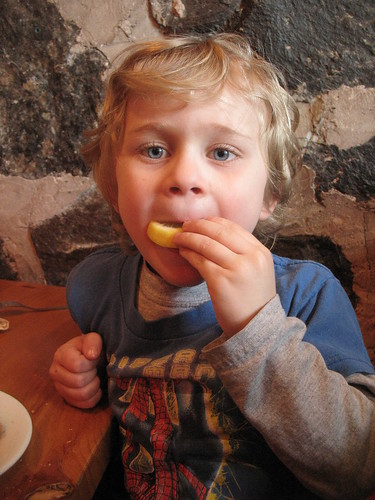
Monkey gleefully requested the slice of lemon that balanced on the rim of Jabber's glass, and then he took huge bites of the sour fruit like he has since he was just a tiny baby, pausing in between each bite to shudder comically, his little mouth twisting up into a pucker.

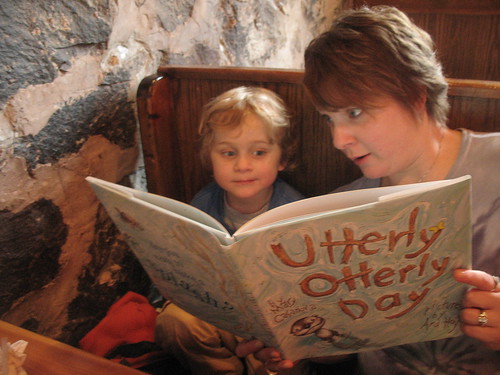
We made a stop at our favorite bookstore (The Bookstore at Fitger's) for some new picture books (and to feed Jabber's Wimpy Kid addiction), and we read the wonderfully onomatopoetic and alliterative Utterly Otterly Day, by Mary Casanova, while we waited for our food to arrive. 

(Yes. I am making a very strange face there.  Not to spoil the book, but there is a rather frightening scene involving a cougar!)


Now I'm going to go back to reading (Fury of the Phoenix by Cindy Pon and Invincible Summer, by Hannah Moskowitz), playing guitar (mainly two Brandi Carlile songs about seven times slower than she plays them), and watching old movies I've somehow never seen (last night was Poltergeist--great fun!)

I'll start on the schoolwork on Sunday night, as usual, and next week will be back to business in the home stretch to summer. 

Sunday, April 3, 2011

when everyone applauds...

This evening, after we had tucked in both kids and turned out the lights, Jabber popped up from his little blanket cave and said, "When everyone applauds for you, do you clap, too?  Because whenever people clap for me, this is something that puzzles me."

It's kind of a typical Jabber-question, pretty obviously something he's been turning about in his serious little brain for several weeks or possibly for the duration of his last three lifetimes.  "Well," said D, "I guess that depends on the situation.  When was the last time people were applauding you?"

And Jabber told us about the integrity assembly, and how "I didn't know what to do with my hands when everyone else was clapping."  I had to go over there and squeeze him tight because really.  What do you do with your hands when everyone applauds?

I am trying very hard to be more graceful at receiving compliments and congratulations (and improving, I think!), but it has always been a struggle. I know that the correct answer is always a smile and a "Thank you!", but that's always hard for me to pull off in real life, though it's getting better.  I remember at my confirmation in ninth grade, I stood on the staircase of my church in a receiving line, and the congregation filed past us, shaking our hands and congratulating us.  I realized afterward, in a state of dire embarrassment of course, that as I was shaking all those people's hands, I had also been nodding, smiling, and repeating, "Congratulations!" to them like a complete idiot. 

So there's my first possible response in the face of a compliment:  complete and total idiocy.  I'll usually get the smiling part down (probably with a blush to accompany it), and then something that makes absolutely no sense at all will come out of my mouth.  These moments are probably not that big of a deal--the other person probably forgets about it after a brief moment of thinking, "Oh, I embarrassed the poor dimwit.  Perhaps I'll saunter over here to the cake table."  But in my head, they replay over and over again.  Me, stammering nonsense.

Another common response is an attempt to deflect the compliment or make it sound like I don't really deserve it.  Oh, you like my hair?  "Gah! It's so unruly today, and it's a little too long."  My shoes?  "Oh, yeah, they were on clearance at Target.  Super cheap.  And look more closely--this buckle part is pretty ugly, no?"  It's worse if it's something I did or created that I'm being complimented on.  I did a wonderful job acting in that performance?  "Oh, I totally flubbed my lines in Act II, and did you see the way I tripped when I was supposed to be chasing Lysander?"  Well, no, Elissa.  They didn't notice.  Not until you pointed it out.

So what's the problem, responding to praise?  Do I really feel like I don't deserve it?  I...don't think that's it.  A lot of the time, I'm actually proud of the accomplishment, or I actually do like the shoes or the hair (after all, I bought them and...got the haircut, haha.)  And really, when someone puts forth the effort of pointing out something they like or appreciate, they really don't deserve to have it thrown back in their face like that. Is it because I don't want to seem like I'm proud?  Like I have a big head?  Does it come back to that thing all the girls used to start their sentences with back when I was in middle school:  "Not to brag, but..."  Or is it just that it feels awkward to have the attention--like Jabber standing at the front of the gym, seeing all the rest of the kids applauding and wondering what he should be doing with his hands? 

So I started thinking about this in terms of my writing.  I haven't been published before, except for one poem in a very small journal that nobody ever read.  The truth is, not that many people have seen my writing.  So I really haven't had to deal with the response people might have to my writing.  Writers whose books are out there in the world talk a lot about how to respond to negative reviews or comments (i.e. not at all!), but now I'm imagining myself at some public event related to my book (eep, hives!), and instead of managing a winning smile and a confident, "Thanks!" I'll be grinning, drooling, and muttering, "Congratulations! Yes, I love this weather!" OR I'll point out all of my misplaced modifiers and continuity errors if they dare to say nice things about my writing.  (I hope there won't be misplaced modifiers or continuity errors, but if there are, I don't need to call attention to them!)

Maybe instead, I could burst into applause?

Saturday, March 26, 2011

readaloud ruminations

I love to read aloud.  In fact, most of the people who have spent any time with me have probably heard me read to them--"Listen to this," I'll say, and read a bit from whatever I'm in the middle of.  I read to my students; I read to my children every night: Sharon Creech's Ruby Holler, Beverly Cleary's Ramona series, Judy Blume's Tales of a Fourth-Grade Nothing, and all of the Laura Ingalls Wilder books.

On many occasions I've read aloud to D. as well, like when we read all of Douglas Adams' Hitchhiker's Guide series or when we finished Neil Gaiman's Stardust on the edge of Lake Isabel in Glacier National Park, pausing in between paragraphs to bang our sticks together to keep the bears on the other side of the lake from wandering over to sample our peanut butter tortillas.

I read on road trips--the hour between home and the grandparents' place is  frequently filled with the sounds of Cornelia Funke's The Thief Lord and Inkspell or Robert C. O'Brien's Mrs. Frisby and the Rats of NIMH.  I even read aloud when I'm all by myself--either from my own works in progress or from published authors, especially poetry.  All poetry gets read aloud.

I read to my students--delivering Old Major's dream speech from Orwell's Animal Farm and Jacques' "All the world's a stage" speech from Shakespeare's As You Like It.  Some of my favorite moments in homeroom are the times I have read to them: for my sixth graders the light and whimsical prose of Katherine Hannigan's Ida B. and the endearingly earnest voice of Addie from Leslie Connor's Waiting for Normal, and my eighth graders enjoyed the heavier themes of Laurie Halse Anderson's Speak.

Maybe I just like the sound of my own voice--it's certainly possible.  But what I love about reading the words of a wonderful author aloud is the music of it, the way the words fall into a beautiful rhythm.  I love to capture that music, or at least to try, to embrace the beauty of dialogue, of a well-placed pause.  And, okay.  I like to have an audience. It's the drama geek in me.

In college, I studied Spanish, and I read almost all of the assigned readings aloud, practicing my accent, enjoying the musicalidad of the words, the way the phrases would almost dance with each other on my tongue.  I think reading aloud not only improved my Spanish-speaking skills, but also my "ear" for the language, and the same can be said for reading aloud in English.

Reading the words of great writers influences my own writing, and hearing them spoken--paying attention to the sound of the words as well as their meanings--inspires me to work toward that same sense of rhythm and...even pitch, it seems, that my favorite authors achieve.


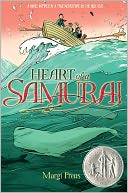
Another thing I love about reading aloud, especially with my kids, is that sense of being able to share what I'm reading with someone else, to hear and see and share their reactions.  When Jabber and I read Kate DiCamillo's Because of Winn-Dixie, we read the last four chapters with our arms wrapped tightly around each other, squeezing tight so we could feel the story together.  I love encountering new words, learning about different times, and places, and the great discussions we get into (even when they're silly, like my sons' fits of giggles that resulted from reading about how Margi Preus' protagonist has to try to drink his own urine to survive on Bird Island, in her Newbery Honor book, Heart of the Samurai, which we're in the middle of reading right now.)

What about you?  Do you have favorite readaloud books, or memories of reading aloud from childhood (yours, or a child you have read to)?  Do you read your own writing aloud to hear the rhythm of the prose, and if so, do you think it helps?

Tuesday, March 8, 2011

dreaming in dialogue...writing woes in the wee hours

Happy for percolating...coffee and ideas!
For about an hour this morning, as I was trying to wrangle a little more sleep before the alarm went off and catapulted me into my somewhat waking life, my brain decided that I needed some writing lessons--specifically, writing dialogue.

I had a creative writing teacher once who said that all (interesting) dialogue is an argument--the interaction serves as a way for each of the characters to make his/her point.  Somehow, the characters need to be coming at the conversation from slightly different angles, and then they duke it out until they agree.  Or until the killer jumps out from the bushes.  Or the world ends.  Or they start kissing, I don't know.

In any case, in my dream, I had to write the scene I had been working on before I fell asleep last night, a scene that has been giving me a wee bit of trouble for some time (or...just possibly, one scene in a long string of scenes that have been tormenting me and filling me with paralyzing and agonizing waves of self-doubt about my worth as a writer and indeed as a human being...but anyway, that's not relevant), and instead of allowing me to wallow about in a restful sleep, my brain kept putting me through these dialogue exercises.

Okay, said my brain, or some cruel dream-time taskmaster, write the scene except Darin doesn't believe anything that Cass says.

And in my sleep, I did it.  I held it up, shiny and perfect.  "NOW can I sleep, please?"

Now write the scene except Darin doesn't believe anything Cass says, BUT he doesn't want her to know that he doesn't believe her.


I mean, sure, I can do that.  Dream-writing elissa writes in her dream.  Sleep now?


Now write the scene except Darin doesn't believe her, he doesn't want her to know, but she suspects that he doesn't believe her and not only does this make her angry but it reminds her of the way her brother spoke to her earlier that day and she realizes, with suprise, that he didn't believe her either.


Yikes.  Okay...dreambrain working working working...the alarm ticking on toward an abrupt and painfully noisy conclusion...YES! There! Perfect!  Dream-writing elissa feels a bit smug.  A bit...genius.


Now make her start to doubt herself, but hide that from him.

Simple!


Now make her hide that from herself.

Arghhhhh!  The alarm sounds.  Groggy elissa swims up out of the murky waters of dialogue exercises, disappointed that she didn't actually write all those perfect conversations in real life...maybe it's enough that she did it in her dreams.