Showing posts with label nostalgia. Show all posts

Saturday, February 26, 2011

road trip (and road kill) reflections...

I finished another round of revisions (maybe close the last one?) on Kiss the Morning Star this week, so I'd like to celebrate by sharing a little bit about the road trip that partially inspired the book, a trip D. and I took about ten years ago and which follows much of the same course as Anna and Kat follow on their "rucksack revolution".  We, too, carried some Kerouac in our backpacks, and like Anna, I carried a notebook in which I tried to capture both our actual experiences on the road and also my thoughts about life and love and truth and beauty and all that stuff that seems sometimes easier to think about while I'm speeding along a back road without an itinerary.

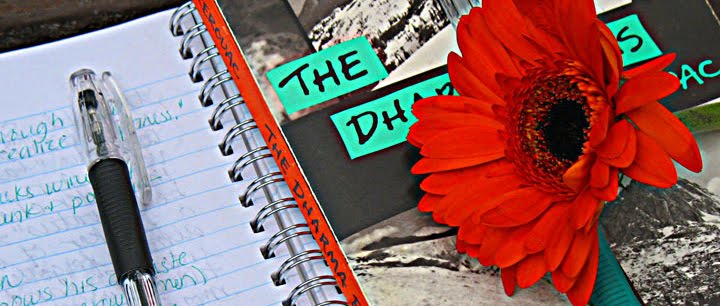
Some of the little details from my old notebook triggered scenes in KtMS, but most of the time, if I tried to put something that actually happened to D. and me on our trip into the book, it ended up not being believable as fiction.  One thing that we have in common with Anna and Kat, though, is the Roadkill Count--a gory list on the back cover of the notebook that documents the dead.  We tried to categorize the animals ("Coon", "Former Flyers", "Brown Furries", "Possibly a Beaver", and sadly, "Collared Critters").  You might be able to see this in the photo (that's my marked-up edit letter and manuscript underneath my notebook, by the way!), but we also wrote a few annotations ("Hit a few times!" "Big one!"), and on this trip we actually added a less morbid "Live Encounters Driving" section which tallies up to almost as many live creatures as dead ones (except one of them says, "Oops, hit this one!").

Several pages of our notebook keep track of the little details of our journey, such as where we spent each of the 77 nights we were on the road, and how much we paid for our accommodations.  We also kept track of every tank of gas we purchased, the price per gallon, and the mileage we got in my heavily loaded 1987 Mercury Grand Marquis, Berta.  The mileage wasn't great, but it is pretty amusing to remember how scandalized we were by the price of gas in certain cities--"It's OVER $1.75 a gallon, what the hell???" 

We also dedicated a couple of pages to silly signs or amusing quotes that we either said or overheard while on the road.  (One of my favorites, written in iridescent pink pen, goes like this:  Elissa:  Oh, it's okay.  I'm just checking to see if I have a live hornet in my pants.  David:  Um.  Maybe you should pull over while you do that?)

Interestingly (to me, haha!), as I flipped through my road trip notebook, I also found--in a completely unrelated part of the notebook that was from before we left--the little character sketch that inspired me to write Kiss the Morning Star in the first place.  The main character of this story was a girl named Harriet, daughter of a minister with a "golden voice."  The story began, "When she was fifteen, Harriet read three books on Buddhism for a research paper in English class.  She learned that life was suffering.  Harriet stood in the shadows between the stacks at the public library, a heavy book in her hands, and thought of her mother, who hated her."

I like being able to trace the origin of this story, and how it has changed and what it has kept--a little bit of Kerouac, a little about her minister father's voice, a little about the tragedy that shapes Anna's journey.  And I like being able to also trace the path of my own journey, so long ago, and to see how it has shaped my writing.  Most of all, I like to think about the experiences of the present, and where they might lead, about ten years from now.   :)

Sunday, February 20, 2011

To the girl with all the secrets...

my secret writing hiding spot has grown...
I've been forcing my eighth graders to write about writing--specifically, they're writing their writing histories.  I'm asking them to start with their first memories of learning to write, and then tell me the story of everything they remember about writing for school or for themselves from then until now, and then to reflect on their views of themselves as writers and what they hope for their writing in the future.  The inspiration for this writing project comes from the book From the Other Side of the Desk, written by my education professor, Linda Miller Cleary, in which she interviews forty eleventh graders about their writing histories in an attempt to make sense of what goes right and wrong for students when learning to write.

My own reasons for doing the project are a little different--while I am very interested in the events and processes that have shaped the writing skills of my students, I'm also very interested in encouraging them to be self-reflective: to think deeply about their own past experiences with writing and to make a path into their futures.  I have found that, for many of them, their prevailing thought about writing has been simply, "Writing is hard, and I suck at it." 

So...each day in class, we've been spending some time writing in journals about our writing histories, and I include myself in that because for much of the time that my classes are writing, so am I.  Sure, I walk around and give encouragement and help, but I'm also scribbling in my notepad, and at the end when we share ideas, I sometimes tell them things that surfaced in my own writing that day. 

Surfaced.  It's funny how it happened--to all of us, I think.  We started out thinking, "Oh, I don't remember anything about learning to write, or about writing in elementary school, or about best and worst writing moments as a child..." and then we started writing a word or two or ten or two hundred...and memories started bouncing up from the bottom.  Memories of writing.

One of the memories that came up for me--something I shared with both of my classes--was about hiding my writing.  For the first time in years and years, I remembered how my bedroom in the old mobile home my family lived in from the time I was in third grade until I started seventh grade had a secret hiding place under the carpeting near the heating vent.  A little sliver of space where I could slide several sheets of paper, folded up into intricate shapes, where nobody would see the words I had written.  Nobody would judge them; nobody would jump to conclusions or make accusations as I processed my thoughts the way I do best.

I remember that when we moved, when a big truck came and hauled our home away at last, I slipped one last sheet of paper into that hiding place.  A letter, to the girl I imagined would live in my room after me.  A girl who, like me, might find herself in need of a secret hiding place, and when she discovered it she would find my words waiting to welcome her.

Maybe a year or so later, I was talking to my mom about the day they came for the trailer, and I told her about the letter I wrote.  She laughed and said we had sold the trailer for scrap, and I remember how embarrassed I was at the thought of some construction workers or something tearing up carpeting to find my earnest epistle to the imaginary girl with all the secrets.

Saturday, November 27, 2010

Dear Life...

I found this"letter to life" in the process of going through my old computer and copying all the near-forgotten files (nostalgia running amok amok amok!) and realized it was written nine years ago to the day (yesterday).  And...I liked it.  It was sort of interesting to see how closely some of the thoughts fit in with the thoughts I've been thinking recently (does that mean I'm always thinking the same things, or does it mean that my introspection spirals round in predictable cycles?) 

Anyway, this photo was another lost-n-found treasure--that's me on New Year's Eve, 2001, at the Eugene First Night Celebration.  I thought it fit with the retro blog post...reflecting on the past, thinking about the future.

Dear Life,

I'm sorry it's taken me so long to write.  You've been busy.  I know I've taken you for granted a lot, but I want you to know I don't mean to forget you.

I've hiked a lot of trails carrying a heavy backpack, and the way was sometimes very rocky.  I remember a trail in the Grand Tetons where the switchbacks climbed endlessly, carved out of the mountain in thick, stony steps, uneven--each step forcing me to heave all of my weighty self onto one raised knee.  I cursed that trail, and I hated that heavy load upon my back, even though I knew it was there to help me stay well--to sleep comfortably and eat and drink fresh water.  And I remember another trail in Glacier, stepping through shoulder-high foliage on a slippery, uphill path covered with bear tracks, fear pounding in my heart. 

Sometimes, Life, you're that dreaded, cursed trail, difficult to follow.  And sometimes a piece of me folds her arms and sits down by the side and refuses to carry her backpack one step farther.  And even then, Life, what do you do but send a swarm of mosquitoes to drive me from my perch.  Bitch.

Still, as I climbed, and as I sang loudly to the bears to mask my fear, I became more whole.  My vision grew.  I became brave.  I carried the things I needed and left the rest in the car.  Without that path, where would my journey lead?

What more can I say to you, Life, in these muddy, clumsy words...these words that stomp impatiently in pastures, yearning for the grasses of other places?  Your beauty can only be captured in the sideways glance, stuttered in the soul, perhaps in a line of poetry.  Only the guttural sounds of the most primal language could come close--the gasp, the sigh, the shiver that runs like lightning up the back of my neck and slides down my arms in a shower of gooseflesh.

Thanks for helping me learn to be patient.  I know I get whiny sometimes.  I'm sorry I've hated you.  Cheated on you.  Cried and wailed, begged you to change.  We don't need to get into the details, Life.  I know I'm the one who changes.

It's okay that I'm not famous yet, Life.  I like the present better when I have dreams about the future.

It's okay that I'm poor, too.  I hope I'll always remember to keep it simple.

I wanted to thank you also for music, poetry, and light.  For the colors of the autumn leaves, the smell of sunny raspberries, the joy of an icy snowball packed with raw, cold hands in spring, the sound of children laughing.

Thanks for forgiveness,
for enthusiasm,
for trial and for error,
for the madness and the serenity.

Thanks for not giving up on me when I give up on you.

Anyway, Life, there was a reason I wrote to you, actually.  I was thinking about all the things about you I'd like to enjoy, and I mean, I can imagine so much to do (thanks, Life, by the way, for imagination), I mean besides being a writer and a backpacker and a poet and a teacher and a photographer and a wife and a graphic designer and an artist and a dreamer in this life, I also would really love to be a painter and a dancer and a tree and mother and a carpenter and a crazy woman and a geologist and a singer and a film director.  And Life, these are only the things I want to do right this second.

So I guess what I'm saying, Life, is please, slow down! Help me remember to play, to learn, to question, to get involved.  Don't let my time get so parceled off to various places that I never have a moment to be alone, to stare into the sky or to whisper a prayer, to paint in the afternoon or to dance with my husband in the kitchen. 

And I promise to write more often.

Love, (thanks most of all for love)

Elissa Janine
Friday, July 9, 2010

"I better go through all my stuff..."

My family likes to hang onto stuff.  We went for an afternoon hike this week, and Monkey picked up these two large, flat river stones.  And wouldn't put them down when we left the riverbank and got back on the trail.

As we hiked farther and farther, and he went longer and longer without a nap, he began to whine and plead with us to carry him.  "I'm not going to carry you while you're holding those heavy rocks!" we told him.  But he wouldn't put them down, even as he was crying with fatigue, until we got to the next river stop and he forgot about them in the moment--and we neglected to remind him.

I admit to collecting wayyyyy more books and journals and art supplies and books than I know what to do with, but every so often it comes over me all in a rush, and I just want to drag everything out into the yard and set it on fire.

I remember how difficult it was to pack up my life and fit it into the trunk of my car (and sharing that with D. besides).  I remember having to choose--which books?  which journals?  could I manage without any paints?  Deciding how many pairs of shoes was necessary, and choosing the small objects that would make our tent into a home, like the mandala rug that belonged to D's parents.  It was a daunting task.

But today I woke up yearning for those days where every one of our possessions is in some way essential.  And also, where every one of our possessions has a specific place it can be tucked away when it's time to move on.

I wake up on a day like this, feeling weighted down by all this stuff.
So there it is--the results of a morning of feverish clawing through closets and drawers, shoving THE STUFF into bags and boxes.  All these old clothes and toys and diapers, goodbye!  And it's funny...it was just one room (I also made a significant dent in my office but that was more filing and shredding, a super exciting story for some other day, some other post...I promise!), but it made me feel so much better.  (Ask me if I still feel better one week from now when the stuff is still piled there by the door.  No, wait.  Don't.  We will ignore that pile if it is still there in one week.  We will pretend it never happened.)

Tomorrow:  we organize the camping gear!  or...we lounge about on the floor, gasping in the heat.  I mean, it could either way, really.  But I am NOT carrying the rocks, no matter what.

(Title is a quote from the poem, "Dream: Us Kids Swim off a Gray Pier" by Jack Kerouac.)

Tuesday, June 1, 2010

eyes on the prize (and off the canoe rack)


Jabber is learning to ride a bike.  A real bike.

"With no training wheels," he says.

So the boys get out the toolbox and dismantle the second-hand bike we got him last summer, and soon he's wobbling across the back yard, back and forth, more feet on the ground than are strictly allowable for actual bike riding but with a lot of bravery.

I take a video or two, and at the beginning of each "take", Jabber solemnly speaks to the camera.  "Riding a two-wheeler is easy, once you get into it," he says, and then staggers off across the bumpy green expanse, grinning a big boy grin.

I learned to ride a bike when I was six--a red, banana-seat bicycle with a white plastic basket and a little silver bell with an American flag on it (which I've mentioned before).  My stepdad figured it would be easier for me to learn with a little hill to get me started, so he took me to the spot where the driveway rambled down the peninsula toward the lake, the gravel turning into grassy ruts.  "Just keep your head up and pedal," he said, giving me a little push.

At the bottom of the hill, near the beach on the left-hand side of the path, there was a giant wooden canoe rack.  I think there was a canoe or two or three hanging on it...that part is fuzzy.  All I remember is that I was terrified of crashing into it.  It loomed in front of me, and I couldn't take my eyes off it.

So of course, I crashed into it.  Hard.  Picking me up from the dust, checking me for more serious maladies than the ever-present skinned knees and assorted bruises, my dad told me it was time to try again.

"But I'll hit the canoe rack," I cried.

"No, you won't.  Just steer away from it."

But every time I went down the hill, I found myself transfixed by the canoe rack, inexorably drawn to it until I was painfully tangled up in it.

My dad was frustrated, but he didn't know what to do except to tell me to steer.  How could I steer, when that gigantic, painful obstacle stood right in my way?  (except, it wasn't in my way at all; it was way off to one side of the harmless grassy path my bicycle was supposed to take...)

Finally, crying and ready to give up, I explained how my bike just gravitated toward the canoe rack, and Randy taught me the trick of bike-riding:  you will always go where you look.  "Look away," he said. "Keep your eyes on the path."

Magic.  I sailed down the road (okay, okay, I still crashed, but not into the canoe rack; that's the important part.)

I've said it before, about writing...there are so many ways to fail, so many reasons to give up, to keep your eyes locked on that scary canoe rack.  To crash.  To get hurt.

I'm not one who believes that positive thinking is a magic spell that will lead to my success, but there's something to be said about keeping my eyes on the prize and off the canoe rack, about setting goals and pedaling toward them.  When I have my gaze fixed on the things I fear, it can feel like I'm hurtling toward them, out of control.  A voice in my head tells me to steer, but how can I, transfixed by the giant failure in front of me (or maybe it's really off to one side, completely off my path)? 

My book is out in the world.  I'm trying to look in another direction, trying to fix my eyes on a grassy path.  Trying to wrap up the school year and plan for my summer and keep my house from smothering us all in its filth.  Trying to keep pedaling.

Last night Jabber braved the alley.  There's a little hill, a long straight stretch.  Rows of garbage cans.  He's brave, much braver than I was at six, and he took off without a push, without any directions from me.  Still, I shouted after him.  "Keep your eyes straight ahead, Jabber!  Keep looking forward!"

He rode straight down that alley, just like a pro.

Sunday, March 21, 2010

ringing my own bell...

I was six, maybe seven, and I had a red banana-seat bicycle with a bell.  I was an only child, and I spent most of my days quietly rambling around the little peninsula of my home--digging in the sand, climbing in the cedars, "discovering" secret pockets of lilies-of-the-valley, making up stories inside my head.  I talked to myself, constantly.

But every so often, I'd get a hankering to talk to someone new, so I'd ride up the dead-end road to the top of the hill--the limit of my solo territory. There, in a house I've forgotten and would probably drive past without recognizing now, lived a toddler boy that I  liked to play with. 


I think I was too shy to knock on their door, or probably my mother had told me not to because knocking on someone's door was being a pest, but instead of approaching their house like a normal visitor, I would instead ride my bike in little circles on the road, thumbing my bell.

Ring-ring.  Ring-ring.  I'd wait, and then try again, a little more quietly.  I knew that it was possible the baby could be taking a nap, and I didn't want to wake him.  But if he was awake, he would hear me out on the road and run to the door, shouting to his mother, "Lissa ring her bell!  Lissa ring her bell!" until she would take him outside to visit with me.

Thinking about this as an adult, I have to sort of cringe at myself, intruding like that on this woman's life.  I remember her being very kind to me, and maybe it was a nice break for her to have a visitor to occupy the little one, but maybe she was actually annoyed with having to watch two children instead of one.

This is leading somewhere, I think.

So I was thinking about this...about how difficult it can be sometimes for me to "intrude" in people's lives.  I hate the telephone, but it's not necessarily talking on it that I hate--I hate calling people because I feel like I have no idea what I'm interrupting in their lives at that moment.  There's a quality of self-assurance that I maybe lack, the assurance that no matter what they were in the middle of, of course they'll be happy to stop and talk to me.  I know this is ridiculous; if they're busy, they can just say so.

I was reading something recently (and if I were a good little blogger there would be a fancy link here or something, but I'm just a lazy writer girl, so sorry, you'll have to take my word for it) about how writers need publicists because they are, in general, a modest lot.  It's hard for us to go around tooting our own horns.  Instead (*tries desperately to make this post somewhat cohesive*), we'd rather ring our bell, quietly, while we make wobbly circles on the asphalt with our heads down, watching the ribbons woven into our own spokes.  We hope that the public will come running with a toddler's enthusiasm, but even that can feel like too much, can make me worry that I'm being intrusive.  I mean, I don't even like to friend people on facebook, as a rule, because I feel bad that I'm making someone else make the decision of whether to accept or ignore.  I worry that maybe they will have forgotten me in the stream of time or more important people and will wonder why they would ever want to read about the minutiae of my daily life.

I was thinking today about joining a local writing group.  This would require me to go to a meeting--to walk into a coffee shop and approach a group of people and intrude--to say, "Hey, can I join you?"  A difficult thing for me to do, in general.  But there have been several times in my life where I've pushed myself to take that kind of risk, to go beyond the quiet thumbing of my bell and the hope that someone will notice and instead have stepped forward bravely and introduced myself to a situation.  These situations usually involve some awkward moments (like when I went alone to audition for the Shakespeare play and nobody really talked to me), but they have usually resulted in really amazing things (like when the stage manager asked me for a ride home and promptly became one of my best friends who is still a part of my life).

Anyway, I'm failing at eloquence, but this tricycle my husband shot a picture of in our backyard reminds me of my seven-year-old self on my red bicycle, and it makes me think I should probably give that writing group a chance.  It was a bit of a stretch to go from there to facebook to phone calls to writing, and I never did manage to tell you the story of how Monkey recently invited himself and David right inside an acquaintance's house and how if it had been me there instead of David, I would never have gone back to the door and he would have cried and everyone would have missed out on a lovely little accidental visit, all because I would be worried about being intrusive.

Sunday, February 28, 2010

"Look at all that water!"


I've spent the better part of the last fifteen years within sight of Lake Superior, and still it never fails to fill me with awe. In college, I had a second story apartment on the Hillside of Duluth, in an old house with three giant windows facing the Lake, ancient glass settling heavily on the sills in a dreamy, wavy pattern, and there wasn't a single day in a single season that I didn't spend time cuddled up in the chair behind the fireplace, gazing out at all that water. In those days, the sound of the old foghorn made me smile in my sleep, and the sight of the Wednesday sailboat races would make me trot down the hill to the Lakewalk to find a sunny perch for writing or textbook reading or just daydreaming.

When David and I returned from our trip out to Oregon, we rented an apartment about a block away from the water, and we placed our bed in the middle of the room next to the window simply to be sure that the first thing we would see each morning would be the sun rising over the Lake in gorgeous displays of color and drama. That summer, pregnant with Jabber, I adopted David's early morning work schedule and rose before the sunrise, hiking down to the shore in the pre-dawn quiet. Each day I took a brisk walk east along the bicycle path to a little sheltered cove and my favorite rock, my sunrise-watching post. I placed myself there with my journal and a little tupperware of cereal and fruit--munching on my breakfast as the sun slowly unveiled himself to the world. I spent an hour writing: my thoughts and hopes, my attempts at poetry, my worries and anxieties about the future. And then, once the warmth of day heated up my stone seat and made me shed a layer or two into my backpack, I'd rise and walk the Lakewalk down to Canal Park and back to my apartment for a nice nap and some time on the computer, working on my first novel. Our apartment was small, the garage precarious, the street out front loud and busy, the heat patchy and unreliable--and yet it remains one of my favorite places in memory.

Our next home was without a view, but in our backyard rose a ridge that, if we dared to climb it (and at eight months pregnant, it was quite a feat!), offered a vista I could spend hours just sitting there admiring. In all the time we lived there, I think of that ridge and the view of the Lake below it as my sanctuary. Little Jabber learned to say "superior" before he was able to walk.

Life with two kids and a full-time job and novel-writing and bill-paying and whatever else is busy. Our cute little house now is close to the Lake but in a flat area, without a view. Still, every day on our drive to work, we climb up a hill and are greeted with the sight of Superior stretching off to the horizon, sometimes frozen and cold, sometimes impossibly blue and inviting, sometimes covered with the white capped waves that remind me of its power. On days like today, when I feel slightly overwhelmed by the world and the looming pressure of Sunday evening, I like to take the kids down to the shore for a few minutes to throw rocks in or play on the ice, and it never fails to make me feel more complete, more at ease.

I remember a hike long ago, when David and I stretched out on our backs in full winter gear on top of a sheet of ice. The sun beat down on us pleasantly, and I could feel his gloved hand squeeze mine through my choppers. Beneath us, we could hear the tiny trickle of water making its way back to the Lake as the ice melted. "Ah, this is how I love to feel," said David. "Slower than a land-locked wave in February."

So this is how we spent the final evening this February, watching the waves roll in.

february 2010 027

february 2010 030

Saturday, December 19, 2009

progress and looking back...

I got my first computer just about nine years ago, in January of 2001. (Actually, that's a total lie, and I just realized it. My dad actually bought me a computer when I was like eight years old--a Texas Instruments thing that I plugged into an old black and white television and copied pages and pages of Basic Programming from a battered manual over and over again in a vain attempt to "see Mr. Bojangles dance"--but this doesn't fit into the story, so let's pretend that computer doesn't exist, okay?)

Up until then, I had done all of my writing on a Smith Corona typewriter in high school, and when I left for college, my family bought me the step up from that--a word processor that had a monitor and could save to a floppy disc, though it still typed my papers out onto the page like a typewriter with a loud, rapid-fire style that really annoyed my roommates when I printed out my essays in the middle of the night.

I still remember how exciting it was when David and I took out a personal loan and bought that shiny Mac G4. It's funny to think about that, how we took out an actual loan to buy a computer. I had been a teacher for two years and had left to go on an adventure out West with my boyfriend and was working in the prepress department of a printing company, a job that had no homework. I was going to be a writer!

It wasn't the first time I had considered being a writer, you know. I wrote stories in endless spiral notebooks from elementary school on, and I remember a point during my senior year when my amazing English teacher (*waves at M.S.*) pointed her fork at me in a somewhat threatening manner and demanded that I become a writer. But it wasn't until I bought that first computer that I felt like I could actually accomplish this goal.

It was that year I started my first novel, The Star Crossing, as well as countless poems and fiction pieces and journal entries. I collected rejection notices from every short story magazine I could find in my thick, dog-eared copy of Writer's Market. I made flyers on my new computer for a writer's group and met every week with the two amazing women who responded. I wrote, wrote, wrote--even penning stories in my journal in twenty-second spurts while I burned plates for the printing press in the tiny plating room.

I had occasion last week to fire up my old computer (which I used as my primary computer up until two years ago, actually) to pull up some business-related graphics for David, and I grabbed a couple of photos and an old short story on my flash drive to transfer to my lappy for the nostalgia. I have most of my documents from that time transferred, but because I was using different software on the Mac, and because I'm fairly lazy, I haven't had a chance to get it all copied. So I spent some time looking over the short story I was most proud of in those days, a story called "Shadows."

And it was weird, so very weird, to look at this piece of writing I hadn't seen for six or eight years, to try to connect it with me--to believe that I wrote it. There's a scene in The Dharma Bum Business where Kat says she doesn't want to design her own tattoo because she knows her art will improve. There may be a point where she's embarrassed of where she was before, and she doesn't want to face that embarrassment every time she looks in the mirror. Looking at my old story, though, I wasn't so much embarrassed as completely perplexed: who was this person who wrote like that?

The writing is rough and naive and yes, I can totally understand why it was rejected, but...the spark in it, the fierce belief in itself, in its own daring...well, I think my current self could learn a thing or two from that writer--the writer who hadn't yet learned about the ups and downs, who hadn't yet doubted herself or censored herself, who hadn't yet worried about the market and whether her work would sell, who believed utterly that the world would instantly adore her brilliance. Reading my crazy old story made me smile; it made me excited about writing, about possibility. And it made excited about the thought of looking at my writing in another eight or nine years, to see what lessons my current self will have for future Elissa.

So along with the story, I dug up this photo of me, with my computer (we named her CalliopeCheetah, the Silver Ponder) and my stacks of notebooks (see them up there on the shelf?) and my keyboard sitting on a board balanced across an open drawer. This is where I became a writer.