Showing posts with label my fifth novel. Show all posts

Tuesday, March 8, 2011

dreaming in dialogue...writing woes in the wee hours

Happy for percolating...coffee and ideas!
For about an hour this morning, as I was trying to wrangle a little more sleep before the alarm went off and catapulted me into my somewhat waking life, my brain decided that I needed some writing lessons--specifically, writing dialogue.

I had a creative writing teacher once who said that all (interesting) dialogue is an argument--the interaction serves as a way for each of the characters to make his/her point.  Somehow, the characters need to be coming at the conversation from slightly different angles, and then they duke it out until they agree.  Or until the killer jumps out from the bushes.  Or the world ends.  Or they start kissing, I don't know.

In any case, in my dream, I had to write the scene I had been working on before I fell asleep last night, a scene that has been giving me a wee bit of trouble for some time (or...just possibly, one scene in a long string of scenes that have been tormenting me and filling me with paralyzing and agonizing waves of self-doubt about my worth as a writer and indeed as a human being...but anyway, that's not relevant), and instead of allowing me to wallow about in a restful sleep, my brain kept putting me through these dialogue exercises.

Okay, said my brain, or some cruel dream-time taskmaster, write the scene except Darin doesn't believe anything that Cass says.

And in my sleep, I did it.  I held it up, shiny and perfect.  "NOW can I sleep, please?"

Now write the scene except Darin doesn't believe anything Cass says, BUT he doesn't want her to know that he doesn't believe her.


I mean, sure, I can do that.  Dream-writing elissa writes in her dream.  Sleep now?


Now write the scene except Darin doesn't believe her, he doesn't want her to know, but she suspects that he doesn't believe her and not only does this make her angry but it reminds her of the way her brother spoke to her earlier that day and she realizes, with suprise, that he didn't believe her either.


Yikes.  Okay...dreambrain working working working...the alarm ticking on toward an abrupt and painfully noisy conclusion...YES! There! Perfect!  Dream-writing elissa feels a bit smug.  A bit...genius.


Now make her start to doubt herself, but hide that from him.

Simple!


Now make her hide that from herself.

Arghhhhh!  The alarm sounds.  Groggy elissa swims up out of the murky waters of dialogue exercises, disappointed that she didn't actually write all those perfect conversations in real life...maybe it's enough that she did it in her dreams.


Monday, February 7, 2011

I dropped a stitch! the terror of the ginormous revision...

I want to write about revision.  No, wait.  Maybe I just want to hide from revision?  Yeah, same thing.

So anyway, I've spent the past year revising--I'm pretty sure, when you break it all down, (*breaks it down*), I have spent more time this past year revising than sleeping.  And a lot of the time, even when I'm sleeping, the better part of my brain (AKA the part not otherwise engaged in drooling over pretty pictures and unlikely scenarios (not like, literally drooling, of course, ew! *flips pillow*)) keeps right on revising.

I struggle sometimes with blogging about writing.  I enjoy reading and commenting on other writers' blogs, but I don't really feel like I can write about "the craft" with any kind of authority.  What do I even know about writing except how much I don't know?  Still, I keep thinking about the revision process, and I keep coming to one big conclusion.  Ready?  Okay.  Revision is...hard.

Yeah.

Brilliant.  So as a writing teacher, I spend a lot of time trying to teach people how to make their writing better.  We do things like peer critiques, where readers ask each other questions about things they want to know more about, or identify language they really think "works"...that kind of thing.  And we do the kind of revision that is more about refining language--identify your lazy words and get more specific.  Read it out loud and find the sentence breaks.  Check your outline and make sure your paragraphs are organized with transitions and a strong thesis...that kind of thing.

Nobody can ever really teach you how to REVISE, you know?  Like, even when a reader (critique partner, agent, editor, your mom--whatever) tells you what's wrong with your novel--that the voice is awesome but everything that happens in it is slightly wrong, or that the whole thing really needs to begin 20,000 words in, or that the stakes aren't high enough or that your central focus seems to want to shift over about three inches to one side and maybe happen in a different state--even then, they can't tell you what to DO about it.

So far I've revised all of those problems and then some, and I still can't sit here on this blog and tell you what to do when you take apart a key scene about three-quarters of the way through and realize that it's like you've just gone to dig out a dropped stitch and suddenly there are all these loops and strings and holes and you're scared to move and your needles are shaking and more loops are sliding off of them every second and you've spent an entire year on getting this far so the thought of ripping it all out and starting over is paralyzing, and...

...well, I'm not sure how else to put it.  It's terrifying.  But you can't sit there all day holding perfectly still with your needles in the air. So...you start tugging at strings.  You pull a few loops.  Sometimes it works to cover the wall up above your desk with post-it notes, and sometimes it helps to make color-coded notes on dot matrix paper and spread it all over the floor, and sometimes it helps to cry and sometimes it helps to paint a deck with music stuffed in your ears and sometimes it helps to take a walk and sometimes it helps to take a bath and sometimes you have to write what's supposed to happen next ALL IN CAPS with things like "OMG THEY ARE FREAKED OUT" and "WHAT WE THOUGHT YOU WERE JUST A LITTLE MESSED UP BUT YOU ARE REALLY MESSED UP" and even "AND THEN HER PARENTS’ HEADS EXPLODE!" (All of these are either my own actual methods of revision or my own actual excerpts from my current document--I left out the somewhat controversial methods of snarling at my family and going on crazed cleaning rampages...)

Anyway, no matter how you cope with it, revising is freakin' HARD.  And what works for one person may not work for another.  What works for me today may not work tomorrow (assuming I eventually post this and get back to work), but the process of making serious, deep changes to a manuscript time and time again (I'm a slow learner) is daunting and difficult.

But.  Here's the good part.  As difficult as it is, and as many times as I feel like a big failure when I have to go back YET AGAIN and rework something I thought was as good as I could ever do in a million years, and as much as I despair with my huge pile of post-its and my fourteen open documents...every single time, something crazy happens.

The book gets better.

And that feels almost good enough to remember it all the way through until the next revision.  Almost.

*opens fifteenth document*

*sighs*

(for the record, because I'm afraid this post might be too short and might not contain enough parentheses, I can only knit in a straight line, like a never-ending scarf, and my options for dropped stitches are three: tear it all out and begin from the beginning (after I get someone to cast on for me because I always seem to forget how), live with a hole in the middle of my scarf, or bring it over to my mom's house and make her fix it...but so far, I have not yet made my mom do my revisions.)

Saturday, October 23, 2010

Boo! spooky stories...

The boys and I got out the crayons, colored pencils, and markers this morning and drew some Halloween decorations for the front windows.  I love spooky things--movies, costumes, but especially stories.  Ghost stories, unsolved mysteries, Gothic stories, stories of paranormal phenomena--the ones that thrilled and terrified me were always my favorites. 

I never liked my spooky books to be too safe.  I much preferred creepy tales with unexplained, somewhat twisted endings or, better yet, the possibility of it being a true story, to the neat, Scooby Doo endings.  Tucked into my safe bedroom, I savored the fear, the unforseen, the uneasy. 

On the night before we got married, David and I hiked in through the old growth forest, about an hour before midnight, with the full moon up above us.  On Hallowe'en night.  We wore our flower crowns the entire night so that we were in disguise, and we left a candle burning outside our tent, a little dish of wine set out for the spirits while we soaked in the hot springs in the dark. 

Last Halloween, I wrote a flash fiction piece for a contest on Absolute Write.  I never write short fiction.  I'm terrible at it.  I can't stop, and every piece I write wants to be a novel all its very own.  So...I struggled a bit with the five hundred word limit, and eventually, that little story is now in the process of inspiring not only one novel but TWO!  One, currently without a title and  known simply as "My Cassandra WIP", features all three of the characters from the short story and the purple hearse as well, but in a slightly less terrifying story.  The short story also inspired my very first Middle Grade WIP, a ghost story about summer camp on the shore of Arrowhead Lake and the desperate ghost of iron miner Otto Jarvi and his long-drowned daughter Lucia.  In this book, the Ouija board and its frightening messages make another appearance.

I'm very excited about both WIPs, so I thought I'd share the story that started it all.  It's 499 words, including the title.


The License

“Put out the light, and then put out the light…”

“I thought a hearse would be appropriate.”  Kayla slaps the handmade invitation down on my desk and peers into her compact, adding another layer of black eyeliner.  “You’d better come.”

“You’d better pass.”  I pick at my nail polish.  Kayla’s birthday is on Halloween, and tonight will be the first year that one of us can drive.  If she doesn’t screw it up.

“You’d better bring the Ouija board.”

I look at the little hearse.  Perfect.  “Séance in the grocery getter?”  I say.  Kayla’s driving her mom’s old station wagon.

She laughs.  “Drew is going to piss her pants.”  It’s true, but Drew’s like that.  She’ll dress up in a princess costume so she doesn’t scare the crap out of herself.

“Be ready at eight,” Kayla says.  “Plath’s Lookout.”

Last winter a car full of kids skidded off the edge of a hairpin curve driving down from the Lookout.  Six dead.  We’re hoping they’ll talk.

“You’d better be driving,” I say.

###

Drew squeezes closer to me, and the sharp point of her glittery pink wing stabs me in the neck.  “God, Drew.  I’ll be bleeding for real.  Relax.  It’s a toy.  Look.”  I hold up the little piece of triangular plastic.

“Cassandra, stop!”  Drew snatches the planchette out of my hand and slaps it back on the ouija board.  “We didn’t say goodbye.  The spirit could escape!”

Kayla and I exchange a glance, but we touch our fingers back to the planchette and slide it across the word “Goodbye”.  Halfway through, the little triangle jerks away, and my fingers almost slip off.  “Kayla, stop it.  You’re freaking Drew out.”

“I’m not doing it.”

I look at her face to be sure, but I can tell by her voice she’s not kidding.  The planchette swings in erratic circles around the board, and then it settles on a rapid succession of three letters.

D-I-E!  D-I-E!  D-I-E!

Drew whimpers.  The air in the back of the wagon grows colder; the two candles are flickering.  My eyes are drawn to the little paper hearse Kayla taped to the window.  “Live it up,” says the invitation.

When I’m scared I get reckless.  “You’re not real,” I say.  “You can’t kill us.  You can’t even blow out our candles.”

D-I-E!  The triangle flies across the board.

“Blow out the candles, if you’re so powerful!  Put out the light!  You can’t even do that!”

“Cassandra!”  Drew screams and grabs my arm.  “GOODBYE!”

We wrestle the planchette across the word, and it falls silent and dead.  We stare at it.

“It’s just a toy,” I say.

“Let’s get out of here,” says Kayla.  She climbs up to the driver’s seat and starts the engine, spinning the tires in her haste.

“Be careful,” Drew gasps, reaching for her seatbelt.  “The curve--”

We’re going too fast.  The corner ahead, the abyss beyond--nothingness lit up by our headlights.

“DIE!” screams Drew.

The headlights go out.

Sunday, October 3, 2010

confessions of a children's book lover

Illustrations by Sharon Wagner
Society of Children's Book Writers and Illustrators--SCBWI--Minnesota Annual Conference in St. Paul, MN  October 2, 2010

My first writing conference was...well, it was so nice that I fear I will overuse the words "great!" "wonderful!" and "amazing!"  I will try to rein in the exclamation points, but the conference was a fantastic experience, and I came home excited about writing.  Which is always a good thing.

The day before the conference, I did a search on twitter and found a few people who had tweeted about the conference, and then I took a look at Anne Greenwood Brown's website, and read about her Lake Superior mermaid WIP.  I also have a Lake Superior mermaid manuscript, in a way, so I sent her a message.  We sat together, and she is a delightful person.  I have my fingers crossed for excellent publishing news in her future, and I'm so glad I got a chance to meet her!

Jay Asher, author of Thirteen Reasons Why, gave the keynote speech  about how to sell a book in twelve years or less; he very humorously related his entertaining path of a dozen years, from his very first picture book submission in 1994 to the publication of his first YA novel in 2007.  As I listened, I started thinking back to my own first attempt at publication and realized that I, too, have been submitting writing for twelve years. I, too, have tried to submit picture book manuscripts in that time, and yes...I, too, have vowed to quit writing, have found myself with an idea I was not yet ready--for a multitude of reasons, in my writing and in my life--to write.  At the book signing, I talked with him about my book blogging students having an opportunity to interview him about the process of becoming a writer, as many of them are very interested in writing books.  So exciting!

In a later session, Jay also gave us useful advice about injecting suspense in every book, every story.  What he said was clear, helpful, and again--funny as hell.  The guy is  a PowerPoint Performer.  The notes made me excited to take a look at my Cassandra WIP with a new eye for the role of story structure in the creation of suspense.

Next Heather Alexander, editorial assistant with Dial Books for Young Readers, gave a presentation about the tools editors use to convince their editorial board about a book, and the way the same tools are revised to sell an author's book to bookstores.  She read us a story and allowed us a chance to practice using the tool on a picture book.  It was interesting, and I gained a better perspective on some of the discussions that my editor, Melanie Kroupa, and I have had--especially the conversation we had before she offered on the book, before she presented KISS THE MORNING STAR to her board.

Poet Susan Marie Swanson gave an amazing talk about creating metaphors for our writing, about the value of literature and the joy of children's poetry.  She was full of glowing recommendations for amazing children's poetry and beautiful readings of all her favorites.  I spoke with her about my students and bought the book This Place I Know: Poems of Comfort an anthology of poems created for New York City schoolchildren after 9/11 (hers is titled "Trouble, Fly").  I came away with ideas not only for my teaching, but also for my writing.  Almost everything I've written has poetry in it in some measure, and I'm struggling a little with the poetry in my Cassandra WIP, so I was inspired on a lot of levels. 

The next session was pretty fascinating...Anne Ursu, author of The Cronus Chronicles, a middle grade fantasy series that looks terrific (my blogger students are going to freak out to read The Shadow Thieves) and also a teacher at the MFA in Writing for Children program at Hamline University, spoke with her editor, Jordan Brown, who edits with Walden Pond Press and Balzer + Bray at HarperCollins. 

The two of them talked about the whole process...the way they work together, how they first started, the steps they've taken at each stage, their thoughts along the way.  The presentation was entertaining and very enlightening--I thought they did a  terrific job making the panel move seamlessly forward.  I really liked what they said about how readers can only read what's actually on the page, and how difficult it can be, as an author, to understand that we really didn't transfer the story of our head as neatly onto the page as it might seem to us.  I could relate to that.  :)

Also helpful was the First Pages critiques, where Jordan Brown and Heather Alexander gave critiques to a number of first pages that were sent in by conference attendees.  I imagine this is a tough job--to articulate their thoughts on a single page, on the spot and in front of a crowd, one of whom is the author of the page.  The two of them did a fantastic job giving helpful and specific criticisms to the writing we heard.  I didn't put any pages in because the Cassandra WIP isn't ready for that level of scrutiny just yet.  I sort of forgot about A TANGLED WEB because writing a fantasy book isn't my focus right now, but it was interesting anyway to hear their thoughts on the other people's first pages.

Overall, an amazing day for writer elissa!


Thursday, September 23, 2010

the devil is in the details

Growing up, my favorite books had nothing in common, on the surface.  I was as deeply in love with the historical feel of Little House on the Prairie as I was with the fantasy elements (science fantasy?) of Mrs. Frisby and the Rats of NIMH, and my favorite book for a long time was this strange paperback my grandma had picked up at a flea market called Charley, or The Girl Who Ran Away--a somewhat bizarre, feverish story about a child living on her own in a chicken coop, crawling through hedgerows and going to Sunday School with dying wildflowers in her hair.

It didn't matter what the book was about; what I wanted was for it to feel so real, so thick with details and rich settings and characters who seemed so entirely believable that I would get wrapped up in the story so tightly that I would forget where I was.  I loved being lost in a book, so far gone the sound of my mother knocking on my bedroom door would make me startle, confused and disoriented in the real world. 

As an adult, that feeling is harder to capture, but to this day, the books that truly amaze me are the books that feel...deep.  Sometimes I think of it as having layers, but other times I think of it like a thick, heavy patchwork quilt.  Every stitch was deliberately placed by hand. Every scrap of fabric has a history you can hear if you're still, if you study it long enough.  There are varied textures and funny smells and a weighty, comfortable feeling in your hands, on your lap.  And when you put it down, set it aside, there's a little moment of longing--a sad little shiver.

I want to write a book like that.  I do.  I'm trying.  But man, does it ever take a long time!

All this was sort of a lead in (or it was supposed to be, anyway) to talk about how I read through the first draft of my Cassandra WIP and scribbled notes about every other paragraph that said, "GO DEEPER HERE!" and "EXPAND THIS!" or "SLOW DOWN AND GIVE THIS SCENE A CHANCE!"  It feels so thin, so very far from that heavy quilt.  It's not even one of those double-layer fleece blankies with the fringes on the edge--the kind anyone can make, provided they can operate a pair of scissors and tie a simple knot.  This book is like...maybe a flannel sheet.

So almost everyone in my online writing group has at least attempted to do literary agent Mary Kole's 100 Declarative Sentences exercise to flesh out characters or settings.  I'm not sure if anyone has actually made it to one hundred, but even so, we've all discovered some useful tidbits about our characters in this way.  I made it to 45 sentences about Cass while I was writing the first draft, which was super helpful.  Some of the sentences actually helped me keep details straight as I was writing, like this:

14.  Cassandra has a sister Dicey, age 15; a sister Lexie, age 8; and a brother Eric, who is eleven months older than she is and will turn 18 at the end of this month.

So mainly, that kind of sentence helps me keep my continuity.  I have a hard time keeping track, for instance, of what color eyes and hair my characters have, or like, if I mention at one point that eating cheese gives them hives.

Other sentences end up telling me more about the character--sometimes giving little bits and pieces of their past lives that may not actually end up in the book, but which may give that bit of different texture to the patch that makes up that place in the quilt.  I learn things about them, like this:

22.  Cass has a vague desire to be a scientist when she "grows up", but she's worried that this is a little too nebulous...what do scientists actually do, in the real world?  She pictures herself in a lab coat, bending over beakers, but...doing what?  All the pictures in her head come out of that old biography of Marie Curie she read for a report in fourth grade.

Now, on my second draft, I'm making sentences for Darin, and Drew, and maybe even Kayla.  So far I'm on Darin number 24, and it's hard, but I've already got some notes in a different colored pen next to "EXPAND THIS!" and "GO DEEPER HERE!"  My favorite discovery is the first moment he ever noticed Cass:

15.  Darin noticed Cass for the first time on an eighth grade field trip to the underground mine.  Something about her face when the tour guide mentioned the underground physics lab reminded him of Meg Murray from A Wrinkle in Time, and he daydreamed a bit about traveling with her through space and time.  Or at least sitting close to her on tall stools, their heads bent together over a Bunsen burner.  He lagged behind the group for the rest of the tour, his mind far away.

So here's hoping that by the time I finish this draft, this story will have a little stuffing!

Friday, August 27, 2010

sucked into a black hole of work? check.

The first full week of work is now behind me (no students until next week!), and I know...I haven't checked in.  This is how my  life works around this time of year:  back-to-school.
  • gazing in a stupor at the four walls of my classroom as though I cannot picture them containing any sort of knowledge?  check.
  • back-to-back twelve hour workdays during which my children forget what I look like? check.
  • never-ending to-do list? check check check...(oh! that wasn't on my list, but I did it so I'm going to write it on my list so I can check it off! check!)
Summer vacation used to be this long stretch of lazy days and reading books and babysitting my little brother and slowly growing so bored that I actually looked forward to climbing on that yellow school bus with its bad shocks and its freckle-faced bullies and its inevitable arrival at school.

I liked wearing my new outfits and arranging my new school supplies.  I liked seeing who got their braces off and who got a bad permanent (um, me...) and who had grown six inches (um, not me...) and who had emerged from the cocoon of summer looking all sexy (um, no comment.)  After that, it was pretty much downhill in my eyes, but at least I was good at sneak-reading and had the ability to do my own thing while absorbing what I needed from the lesson with my spidey-senses.  (I know. I was rude and insolent and snarky and lazy.  I know it was obnoxious of me to still get straight A's.  Believe me, I pay penance for my middle school self every day.)

As an adult, though, summer seems to shrink every year.  I have big dreams that second week of June--all the wonderful things our family is going to do, all that lovely together-time.  We'll go camping; we'll go on amazing road trips.  We'll have fires on the beach and hang out with friends and read giant stacks of delicious books.  I'll paint a masterpiece to hang on my living room wall.  Hell, I'll paint my back deck before it rots right out from under me.  And then, about halfway through July, I realize that I'm only going to accomplish a tiny fraction of those dreams.  The camping/road trip money is spent replacing a dead clothes dryer, and then on replacing the washer, which dies shortly afterwards of a broken heart.  The husband has to go to work in the middle of the night and can't really stay awake for a bonfire or many nights out with friends.  The kids fight each other with tree limbs in the backyard while I wonder if the stain will even stick to the deck in 96% humidity.

So this year summer was simply not quite long enough for me to paint my masterpiece.  (Um, or even finish painting the deck...but before you judge, it's a HUGE deck, with all this underneath stuff and skinny rails that needed three coats and walls of lattice...and I've still got time before the snow flies!)

It was just exactly long enough for me to finish a first draft of my newest novel.

It was long enough (plus one day) to finish my first pass of edits on KISS THE MORNING STAR.  (YAY!)

It was nearly long enough for me to forget all my passwords at work.

It was enough time for me to read somewhere between 25 and 30 books (several of which were chapter books I read out loud to the boys--Oh, how we love Ramona and Beezus, Laura and Mary, Peter and Fudgie!)

And it was just about exactly enough time for me to be able to look out at a crowd of middle schoolers (which I would possibly have referred to as a horde of hoodlums mere weeks earlier!) and think, "Awwwww, look at how cute and shiny they all are!"

So happy back to school season, and I will try to squeeze a little blog post here in between the book reports. 


Monday, June 21, 2010

rainy monday...

...so we had a little geography lesson and then made fingerpaint maps.


Jabber was able to name all the states that I flew over on my mini-writing vacation my lovely host Amy Danziger Ross, (and we did get writing done, though to be honest the conversation and celebration and the bottle of wine from my old home in Eugene would have been worth the trip even if I didn't get anything at all done on the Cassandra WIP!)

Summer vacation is off to a wonderful start! 

Wednesday, June 16, 2010

couldn't do this without you...

About two and a half weeks ago, I spent a weekend grading papers--book reports mostly--on my dining room table.  For like eight hours each day, I sat at that table and graded, wrote comments on papers, punched numbers into the calculator, and entered grades on my laptop, which was sitting off to one side.

At the same time at school, I was putting together a slideshow for our eighth grade graduation, sorting and sizing hundreds of photos and placing them in the slide show.

My wrist started to ache.  Then my elbow, my entire shoulder.  I wore a brace on my wrist for several nights, then full time as it didn't improve.  I tried an elbow brace, and still it ached.  Finally, I got into the doctor and went to physical therapy, where she stretched my neck out and POOF! pain was gone.  For two weeks, I had been thinking I had a sore arm, and I actually had a pain in the neck. 

While I was in too much pain to write, I did some beta reading and also read through the first 40k of my Cassandra WIP, which I haven't been working on since I put it aside to begin agent edits on KtMS.  And I found it actually helpful, if frustrating, to be injured while reading--to have actual physical pain every time I reached to correct something, to make an edit.  Editing at the sentence level, at the paragraph level, is an important step in the manuscript's development, but sometimes you can get caught up in the little fixes that you miss the actual source of the problem, which is that whole scene should probably either disappear or be completely rewritten, and this other character's motivations are all stemming from the previous scene, and now this one is inconsistent and really, the whole story should begin about thirty pages in anyway...

Anyway, this post is to say thanks to everyone who helped me out in the last couple of weeks--entering grades for me, finishing the slideshow, cleaning my classroom, taking down chairs so I could have conferences...

...and on the metaphorical side of the post, I'd like to say thanks to everyone who has helped with my book that is currently on sub with editors.  You know who you are, and you are so many, wonderful people.  Thanks for helping me find the source of the weaknesses and thanks for encouraging me when I didn't really see the point of continuing.  My dharma girls have come a long way from their beginnings, and who knows what's next?

And now I should probably go back to drafting Cassandra!  Can I get to 44k today?

photo credit David Hoole Photography, 2010 

Saturday, May 15, 2010

perfect timing?

One of my goals for the year has to do with how I react to getting feedback on my book.  In fact, the actual words I  used were, "I'd like to remain thoughtful, objective, gracious, and rational about anything that happens with this book."

It's a lot to ask of myself, really, and I was completely nervous about a month ago as I discussed revisions with Sarah.  Anything that happens.  I asked myself, "Can I remain objective and rational and even GRACIOUS if she tells me something that sounds impossible?"  I was so nervous about getting her notes that I didn't even know if I wanted to get notes at all.  Maybe we could just stop here?  I could be like, YAY my book is pretty and unique and someone believes in it, the end.  Every step forward has so many possibilities, about half of them stinking suspiciously like failure.

But of course I'm not going to let a little panic (I mean apprehension, obviously) get in the way of moving forward as a writer, right?  So I read through my manuscript again during the time I knew Sarah was reading it, trying to see it from her perspective, trying to imagine what she was seeing.

And then I got her notes in my inbox (incredibly detailed, amazing notes, btw!).  And then my computer died.  On the same day.  Perfect timing.

At first I thought this was a catastrophe.  I mean, I printed out her notes from my work computer and took them home overnight--I hoped at this  point that my computer might have a little update issue that might take twenty or thirty minutes to fix.  I read through the notes, getting more and more inspired and anxious to dig in.  But it turned out my hard drive had failed, and although I had everything backed up (on paper and electronically), I didn't have my computer for the next three weeks. 

Objective and rational and gracious.  Right.  I was freaking out.

Something about me--even though I had been perfectly patient about doing these revisions earlier, and in fact had been fantasizing about never doing them at all, once I had my notes and my ideas and had spent some time on the phone with Sarah...I was ready.  And when I'm ready to do something, let me tell you, it gets done.  I wanted to work straight through the next week, nailing each change.  But the little table where my laptop sits was empty and forlorn.  Instead I had a monster binder, stacks of paper, two colors of sticky notes, and a birthday journal, mostly neglected in favor of the keyboard, which translates my thoughts into words so much faster, so much more freely...

Thoughtful.  Objective.  Rational.  Gracious.

I took the cap off my pen.  I started making notes.  Two weeks later, my mom lent me her laptop so I could translate all my scribblings into the actual manuscript, and now today I'm reading through again.  And again.

Someday soon I'll send it back, my fingers crossed, my goal in mind.  Maybe it will come back with a new set of notes.  Maybe it will go on to the next stage.  This timing wasn't what I had hoped for, but revising slowly, gnawing my pen cap between my teeth like the days before I had a computer (yes, I do that)--maybe it was better for me after all.  Maybe it really was perfect timing.

Just a little update.  I hope to be done for real sometime this week.  And then...who knows?  My lappy is back with its shiny new hard drive, and I know that once I hit send I'm going to be back to focusing on that goal of mine.  And back to first drafting the next one!  :)

Saturday, March 27, 2010

the haphazard reader

Growing up, I couldn't get enough of reading.  People often describe themselves as voracious readers--and this was me exactly: ravenous, insatiable, even gluttonous.  Reading was my favorite thing to do, and I hated to stop.  If I had been allowed to do so, I would have read through meals, through social events, until the wee hours of the  morning. 

My parents bought me books.  Other family members bought me books.  I read them all, and when I was finished, I read them all again.  I read through boxes and boxes of old books my grandma got at estate sales and auctions--dusty hardbacks from old people's basements (I also read all these outdated school "readers"--full of strange short stories and poetry and prayers and little morals, on stained yellow paper).  I read encyclopedias and Reader's Digest Condensed Books.  Old science textbooks and Apple paperbacks from the school book orders that I begged my mom to order. 

Sometimes we went to the library, and I remember filling my blue plastic library bag so full of paperbacks that the drawstring cut into my hands.  Because I liked to reread my favorite books so many times (and my favorites were many--A Wrinkle in Time, Mrs. Frisby and the Rats of NIMH, all the Little House books, Nancy Drew, Starring Sally J. Freedman As Herself, Harriet the Spy, and so many, many others...), I saved my library trips for the silly romance books or ghost stories or paperbacks I knew I'd read in one sitting, the books I knew I could bear to give back when I was done.

I never once felt like I had too many books, or not enough time to read.  It was the opposite; I was constantly scrounging.  Pilfering.  Scouring shelves. 

It wasn't until college, as an English major, that I started to have any kind of rhyme or reason to what I was reading, and that was only because I had so much assigned reading that it was all I could do to read that.  It was the first time I can remember having too much to read, the first time I felt the real scope of the literary world--the fact that I would actually not be able to read every book.  That I would have to make some decisions, to begin the process of figuring out what makes a book worth my time to read.  It was also nice to have a method to my madness, to focus my explorations of the "canon" and discover some of the brilliant works along the edges of it as well.

Since college, I've fallen back into being a haphazard reader.  I read what falls into my hands, basically.  Free boxes, school book orders (reading MG and YA books has been a constant since I started teaching, which eventually led me to try my hand at writing YA, which has led to a bunch of wonderful things, but that's another post entirely!), book club selections, classics from my school library, gifts from my librarian mother-in-law, paperbacks passed on by my mother, books that arrive in the mail because I somehow got enrolled in some book-of-the-month club.  Random reading.

This is so far from systematic.  I'm not good at being aware of contemporary fiction, reading reviews, making a to-read list, prioritizing.  I'm more likely to wander a bookstore looking for covers and first pages that snag me.  A  little over a year ago, I made a goal to be more intentional about  my reading.  I started a LibraryThing account so I could keep track of what I'm actually reading (I tend to forget), and I vowed to review everything I read, even though when I started I wrote about them in a friends-locked livejournal post marked "Not-A-Review" just to make sure everyone understands that I have no idea what I'm talking about.

I'm getting better.  I have the feed to the NYT Books section in my netvibes homepage, and I try to look at it a bit, even if I don't read everything.  I write down the names of authors I want to remember, and sometimes I even manage to read something by them.  I seek out recommendations from people who share my tastes.

Right now, my focus is on reading books that will somehow inspire or inform my writing.  With my current WIP in mind, I have recently read or am reading: (my thoughts on the books on librarything.com are linked; I try to be balanced and reasonable about what I write, but I'm not a professional reviewer, so take them as they were intended: notes to help me remember what I've read and to help me reflect on the strengths and weaknesses of books in order to be more intentional about my reading habits.  I know there are a lot of sticky places to step in when you're a writer and you talk honestly about books, especially books in the same genre you are writing in.)
 
The Lottery by Beth Goobie
at Sarah's suggestion, for the wonderful use of tone.


Some Girls Are, by Courtney Summers,  
because I've heard so many good things about it, and because my WIP shares some themes dealing with bullying.


The God Box, by Alex Sanchez, 
as character research and some insight into conservative Christian viewpoints of homosexuality.


 and The Castle of Crossed Destinies, by Italo Calvino
because the Tarot is a big part of my WIP (not quite finished with this one). 


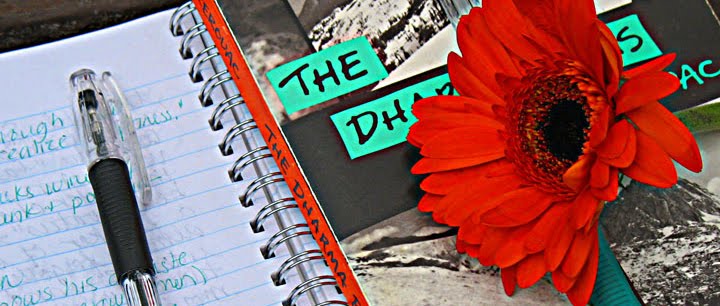
Right now I'm getting close to the point where I need to make a mental shift from first-drafting this new WIP to working on edits for TDBB, so I'm thinking about reading the copy of On the Road: The Original Scroll that I bought for David for his birthday (assuming he finishes first, that is).  I reread The Dharma Bums while I was working on the first draft, actually trying to read it at the same pace as Anna and Kat did and then flipping through it for the bibliomancy parts like they did as well.  I'm also reading Desolation Angels for the same sort of inspirational reasons, but I've tried to make it through this book before and failed. 

So how do you choose the books you read?  If you're a writer, do you read books that are somewhat similar to yours or avoid them?  Do you read more fiction or nonfiction?  Do you wear out your library card, or are you like me--longing to reread the books you love or even just to see their spines on your shelves?  Do you read one book at a time or three or four at a time, like I do?  Do you write reviews or ratings on a site like LibraryThing or Goodreads?   Do you read books your friends recommend?  Do you read reviews?
Tuesday, March 23, 2010

I'm teasing...

...but I won't make a regular thing of it, I swear. 


So I'm a teacher.  My students are on the young end of the YA age bracket, but I admit that they, along with  my own memories of being a teenager, influence my writing quite a bit when I'm writing for teens.  So it's kind of weird to realize that in the three finished YA manuscripts I have, there are barely any scenes in a school.  Sure, the history teacher (and her badass metal sculptor girlfriend) are big characters in Just Think, and okay, so there used to be a couple of high school scenes in the long prelude to the real beginning of The Dharma Bum Business, back before I cut off that first 15,000 words or whatever.  (There was even a slightly...er...eccentric media center specialist who may possibly have seemed a teensy bit familiar to those who have some shared schooling experiences with me, but of course, all characters are a work of fiction.  And stuff.)


But for a person who spends so much of her life in school, writing about other people who spend so much of their lives in school, there has been remarkably little school in my books so far.  But not this one.  My current WIP actually takes place mostly at school, and it's so weird.  I have to write about teachers.  A lot of YA features terrifyingly awful teachers, or completely clueless teachers, or teachers who aren't really sure about the boundaries of professionalism.  This bothers me, as a teacher reading the book--after all, the teachers I know and love are astoundingly full of awesome at all times--but it serves a purpose, of course, which is to create conflict and personal growth for the teens who are experiencing the story.


I have decided that the only real teacher with lines and face time in my current book can't be evil.  He can't be completely clueless, either.  And he most definitely cannot be creepy.  So instead, I believe I have settled on dorky.  Which of course is true of all adults.


Anyway, I'm posting one excerpt from my work-in-progress, and it's a rough draft, but this bit makes me smile a little and wish that my main character would let the dorky teacher help her out a little bit.  Cassandra has to write a "Song of Myself" based on Whitman's poem, and she feels like there is nothing about herself to celebrate. 

Mr. Dawkins taps the edge of my desk.  "So did you make something up?" His voice is gentle, but the set of his mouth means business.
 
"I'm still working on it."  I work on shrinking down to a size so insignificant he will forget that I exist and pass on to the next slacker, but he doesn't budge.

"Let's see what you have so far."  His persistence is admirable for a veteran teacher.  Most of the faculty at Gordon have already settled into the pre-retirement mode of half-hearted, long-memorized lectures and prolonged sessions of busywork.  Mr. D. insists on being one of the ones who still pushes, relentlessly, against the tide of student apathy.
 
"It's too rough," I say.  "I'll show you when I get it polished."

"Show me, and I can help give some revision ideas."
 
Panic.  I can't show him what I have; he'll be harder on me than Darin was.  "It's on my computer at home."  The old stand-by excuse.
 
"Recreate it here," he says, and he officially becomes the second person to pick up my notebook without my permission and open it up to a blank sheet of paper.  "Now.  I'll be back to check it out in ten minutes."
 
"Now you're screwed," says Darin out of the side of his mouth.

"Sure."  I draw geometric shapes in the top margin of my paper.  "I celebrate myself and sing myself, for I am screwed."

"Write it," says Darin.

"Write that?"

"Write your song.  Write Cassandra."  He's doodling, too, like he always is, except is that me he's drawing?  A spiky-haired girl with manga-eyes glares up from the faint blue lines.  In her hand she wields a crystal ball.

 "I'm not…"  I don't finish it.  Somehow I don't mind his vision of me.

 Ten minutes later, my paper is still empty, and Mr. D. keeps me after class to discuss my midterm grade, which will be an F unless I turn in my poem on Monday.

 "I will, Mr. D.  I'll finish it this weekend, I promise."

 "Cass?"  He looks as if  he might try to pat  my shoulder.  I take a step back.

 "Have a good weekend!"  I force a smile and start toward the door of the nearly empty classroom.

 "Is everything okay?"
 
I feel a little bad about blowing him off like this.  He's a genuinely nice guy, and it's not really his fault he's a teacher.  I mean, how many jobs can there possibly be for guys who wear corduroy blazers and get all jittery over the words of some dead guy's poetry?  "Everything's great, Mr. D.  See you Monday!"  And I am out, merging into the slipstream of hallway traffic before he can say anything else, anything that would change even the slightest fiber of my existence.

###


Well, Mr. D. might be a dork, but he's no match for me...